From youth football in Oak Park, Illinois, to professional volleyball in Puurs, Belgium, Justin Cousin’s journey is one nobody saw coming.
Professional volleyball player: a phrase few people in the United States ever hear. A young black man, with an education degree traveling to Slovenia to try to become one; this might be the first time these words have ever been written.
Justin Cousin makes people feel important. He gives people his most sincere assessment, never holding back, even if it means telling a fourth-grader they cheated during summer camp. At 6-foot-2, 215 pounds with a full black beard his presence alone commands attention. When he speaks, especially about volleyball, people listen. In fall 2015, the charming and charismatic 24-year-old accomplished something that was unimaginable a decade ago. He became a professional volleyball player.
He traveled 4,721 miles across the Atlantic to play, but long before that, he made a different jump. In fall 2007, he transitioned from two of the most popular American sports, to one on the outskirts.
Cousin grew up playing football and basketball. Overweight, but agile, athletic and strong for his age, he excelled at both. He wanted to play quarterback as a freshman at Oak Park and River Forest High School. But like many hopeful young skill position players, especially bigger kids, he wasn’t given the chance. Instead he was stuck on the offensive and defensive lines.
“Hoop dreams were alive”
He had no interest in becoming a 300-pound grunt, while he watched teammates prove inept at positions where he knew he would dominate.
After football, basketball was his winter love. “Hoop dreams were alive” and well, Cousin says animatedly.
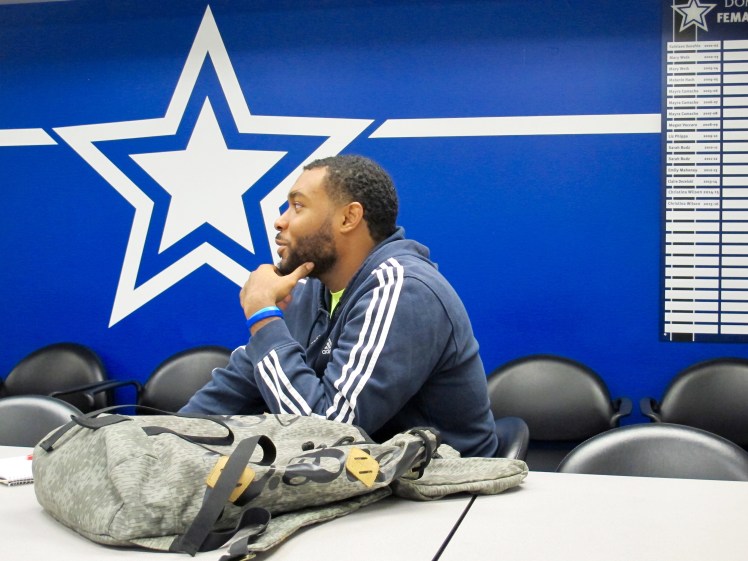
Volleyball came last. It was a time structuring spring activity to help him stay in shape. As a freshman, he was convinced he would “never care about losing a game (of volleyball).” Although he played in middle school with many of his friends, as a freshman they didn’t play, yet he began to be drawn to the sport even more.
Cousin chose to end his own basketball aspirations sophomore year, and he didn’t even consider giving football a second chance. Opting instead to play club volleyball. He chose the potential of the former pastime over the uncertainties of his first passions. Cousin began to love volleyball not because he quickly dominated. The eight-foot net proved a bit too tall, but he impacted the outcomes.
He fell for the opportunity, and for growth.
Cousin’s high school coach, Don August, has dedicated much of his life to the sport he fell in love with as a fellow would-be football player at the University of Illinois at Chicago. He saw Cousin’s transformation from a fun-loving 250-pound freshman, to a 205-pound standout in a great men’s volleyball state. He turned into a different player, but he was already unlike most.
“Just different… I have never heard another player hit the ball and make that sound.”
Most guys don’t play volleyball. It ranks 14th in total in high school participation. It is only registered in 24 states. During the 2014-15 school year only 54,418 guys played – 432,569 played soccer. Black guys play volleyball even less. If you go to the Illinois state tournament, or a crowded Team USA match at the Sears Center Arena there are few non-white faces.
This doesn’t bother Cousin.
His parents were initially apprehensive about him being a rare minority in mostly white men’s volleyball. However, he has been treated more than fairly based on both their assessment and his. He stands out on the court because he looks different. But that is not what truly sets him apart.
Cousin is different in his self-assurance, drive and journey towards success.
Unlike most athletes who go on to play in college, Cousin didn’t earn a starting varsity role until his senior year in high school. He spent his first three years playing almost every position possible. Time spent honing every aspect of his game.
Cousin’s transformation into one of the top players in Illinois was no accident. He spent most of his free time playing. He played on the beach, and at the sand courts near his house. He even found an open gym while vacationing with his family in Texas. His singular focus helped him shed the weight and capitalize on his pivotal senior year.
August, who has coached volleyball since 1981, describes Cousin as “just different… I have never heard another player hit the ball and make that sound.” The loudest of gyms will briefly pause when he contacts the 10 oz ball. His powerfully long swings sound like cannon fire.
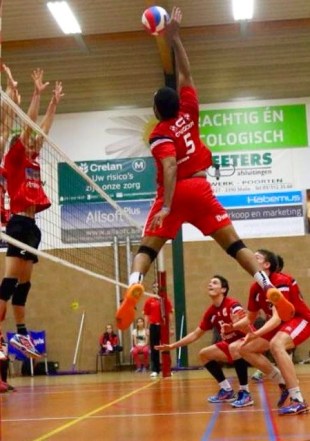
Being different is what has made his volleyball journey possible. He was more dedicated than many teammates. He cared more than all of them. And he wanted as much responsibility as possible. “Set me every ball,” he would say.
In spring 2010, Cousin simply took over. He was in the best shape of his life and was the focal point of his team’s offensive attack. He more than doubled his next closest teammate in kills. He was a show, and a showman. Opposing coaches, in hostile environments, took notice.
“You’re the best outside in the state,” said one rival head coach to Cousin after he almost singlehandedly won the match. His eyes light up when recounting this years later.
His high school career ended in a far too early exit from the playoffs, but the Chicago Sun-Times All-Area Player of the Year parlayed his newfound love into something bigger.
Cousin didn’t want volleyball to end after high school, so before it did, he sought out opportunities to play in college. He applied to universities hoping to walk-on at a Division 1 program.
He ended up attending Saint Xavier University on Chicago’s southwest side, on a dual scholarship.
August helped Cousin secure the much needed face time with their head coach. Bob Heersema saw Cousin play just once near the end of his high school career. But once, was all it took. Heersema offered him a partial academic and athletic scholarship to the private school. Cousin happily accepted. He could keep playing the sport he loved at a high level. And he did, in the National Association of Intercollegiate Athletics.
Cousin had a very successful career for the Cougars, finishing second in career kills and matches played. But team success never materialized. His career on the court was highlighted by a televised match against Robert Morris, at the home of the two-time national champions, Loyola.
He officially graduated from Saint Xavier in December 2014, after completing his student teaching the fall after his senior year. But he wasn’t ready to become a high school English teacher just yet. He wasn’t ready for the volleyball ride to end.
“I’m not finished,” he told his family. “I still got this itch…”
While substitute teaching at his high school alma mater during spring 2015, he researched where and how he could keep playing. He found a volleyball agency online, Bring It Promotions, that helps aspiring players pursue professional careers around the world. And there were some opportunities overseas, mostly in Europe.
“I know I’m going somewhere.”
But Cousin was confident he could become a pro, announcing, “I know I’m going somewhere.”
He had his parents’ support. Janice Cousin, his mother, started a Go-Fund-Me campaign to help him chase the chance. Double-digit donors helped raise $990 of the $3,000 goal, money he earned coaching paid for the rest.
In August 2015, an exposure trip arranged by his agency led him to Ljubljana, Slovenia for two weeks of tryouts against players much bigger, more experienced and who rarely spoke English.
His initial two-week trial didn’t earn him a spot. But he stayed in Slovenia to tryout for a different team, Fužinar Metal Ravne, in the Slovenian first-league. With only one spot available, at a position he hadn’t played much, no offer was extended. So Cousin returned home.
But, there would be no time for sulking. A small Belgian team, VC Argex Duvel Puurs, couldn’t start their season without an outside attacker. His agency called presenting the opportunity. With his 50-pound bag still unpacked, he didn’t hesitate. Neither did his mother. “Just go,” she told him.
Three days later he was on a plane headed for Puurs, a tiny Belgian city 40 minutes north of Brussels.
Cousin did not travel halfway around the world to live the glamorous professional athlete life many think of. The city is home to only 16,000 people. The second-division, Liga B, team does not play in front of thousands of fans. He did not earn a massive salary.
But he was living a dream.
The team housed him. The three-bedroom apartment he shared with two teammates was next door to a Colruyt, the regional equivalent of Walmart. He was a frequent patron. The team gave him a car, and unlike most pro athletes he cruised around tiny Belgian streets in a ’92 Ford Escort. Only after teaching himself how to drive stick shift. His minimal salary went a long way at the time, allowing him to explore Europe when he could.
“I never saw him hurting someone with words, just with spikes…”
He played in 13 matches for VC Argex Duvel Puurs, and held his own in a league where he was often one of the shorter players. Cousin’s 6-foot-6 wingspan and power make up for his lack of height. He routinely got crowds of roughly 100 people, some of whom gained free admission to matches from the connected bar, screaming louder than himself.
Cousin was “famous” in the small community. Despite the occasional questions of, “are you from Africa,” which he laughed about then and now, he relished his time abroad. His professional volleyball experience was about seizing an opportunity, more than winning or living some sought after lifestyle.
Many of his teammates made similar journeys, hailing from Australia, Brazil, England, Iceland and Romania. A Hungarian friend shared his grandfather’s experience with communism. Time spent outside of the gym opened Cousin up to new cultures. He understands the differences, but more so they helped illuminate the shared human journey.
However, he doesn’t think Bruges is worth the trip. He just couldn’t see the appeal in the canal-filled Belgian city.
Thousands of miles from home, with teammates from all walks of life, Cousin was always himself. “Clear… when he wants to say something… but I never saw him hurting someone with words, just with spikes…” said Brazilian teammate Eder Pinheiro.
He went to Belgium to compete. “We worked really hard,” Cousin said, but the effort rarely translated into winning. His professional career was highlighted by a Belgian Cup match against one of the top teams in the first-division, Liga A, featuring multiple players on the Belgian National team. Cousin wore his Duvel beer-sponsored Erreà jersey with pride, and “showed out” against some of the best players in Europe.
Cousin’s pro volleyball career was cut short due to visa confusion. He only had a six month travel visa. His coaches thought he would be able to hop on a flight and get it renewed in the U.S. without any issues. As it turns out, it is far from a simple process.
He was able to compete in only half of his team’s season before returning home in January 2016. Cousin thought about going back to finish the season that was slated to end in late April. But continued visa complications and the devastating terror attack in Brussels, the capital of his briefly adopted home, made him reconsider.
Cousin’s volleyball journey didn’t end in Belgium. It was just the culmination of a fantastic first set. He is still playing volleyball. And he is having more success than ever before, playing competitively against some of the best players in the U.S.
He was an all-tournament team selection at the USA Volleyball adult nationals in Orlando, last May. His team, The Original Bombpops, were crowned A-Division National Champions. And he is already looking forward to going for the repeat next year in Minneapolis.
These high-level, non-professional tournaments and matches take place year-round. Cousin believes some of the competition is even better than he saw overseas. He runs into guys he played with and against in high school and college, at nearly every event. The men’s volleyball community is small and tight-knit, which is something Cousin relishes. It facilitates more trash talking and an even greater sense of satisfaction when he beats them.
“Do you want to be the best? Then show me.”
His volleyball life is transforming. He has dedicated himself to passing on his knowledge and passion for the sport, for generations to come.
He is still the same kid who pushed himself to be his best. Now he is in the position to instill that same drive unto younger players. Cousin is currently an assistant coach of the Dominican University women’s volleyball team, in River Forest, IL. As an assistant, he has sunk his teeth into scouting opponents, even driving to matches when video isn’t available. He revels in finding weaknesses, and urges his players to exploit them.
Cousin’s booming voice can be heard vigorously driving home his message during preseason two-a-days. He is unafraid to be harsh, or say exactly what is on his mind. Although his team has not gotten off to a start anyone would hope for, they have fought hard, despite playing one of their league’s toughest schedules.
He also recently accepted the offer to become the head coach of the freshman boys’ team at his high school alma mater, beginning next spring. His plate will be more than full in the coming year. On top of tutoring high school English during the day, he will be coaching a total of four different programs.
Cousin is a “floater coach” at DePaul College Prep, and he will take the reins of the junior varsity team for an extended period of time this fall. He is also coaching three different levels of club volleyball, at one of his former clubs, Chicago Elite.
He hopes to inspire young people to play his sport with reckless abandon, to never regret a moment. Asking of them, “Do you want to be the best? Then show me.”
He pushes people. And sometimes this can rub them the wrong way. He received his first ever parent complaint after six years of coaching youth volleyball, and he was “pissed off.” Cousin is hard on kids for a reason. He gives it to them straight. He will tear them down, but at the same time he builds them up. He preaches hard work, but always peppers in positivity.
Volleyball led Cousin through eight different European countries. His Belgian experience opened him up to new people and cultures, but it didn’t change him. He has always been himself. Completely comfortable, self-aware and unwavering in his enthusiasm.
Cousin’s passion for the sport is on display whenever the subject is broached. That love brought about every volleyball opportunity, and it will continue to.
His journey is still alive, it just looks a little different.
 Ben Rains